Career development
How to choose a practice group - a practical framework
A practical framework for choosing a practice group, so you pick an area that suits you rather than falling into one.
The short version
To choose a practice group, weigh the factors that matter to you — the people and mentorship, culture, career development, the actual work and its rhythm, plus reputation, work/life balance and opportunities — and use a simple weighted framework: list your factors, weight each by importance (totalling 100%), and score each practice group out of 10. Trust your gut too; you're not locking in your whole career.
Choosing a practice area and team is a big decision for many junior lawyers and law students. When I started out, I worried I'd end up in an area I wasn't interested in — or worse, with a team that didn't offer the support or lifestyle I needed. This guide sets out factors to consider, based on my research and interviews with practising lawyers, plus a simple framework to weigh up choices based on what's important to you. I still think it's best to trust your gut (I never thought I'd end up a construction lawyer), but hopefully this helps if you're unsure.
Framework for choosing a practice group
You can download the framework spreadsheet (Word) .
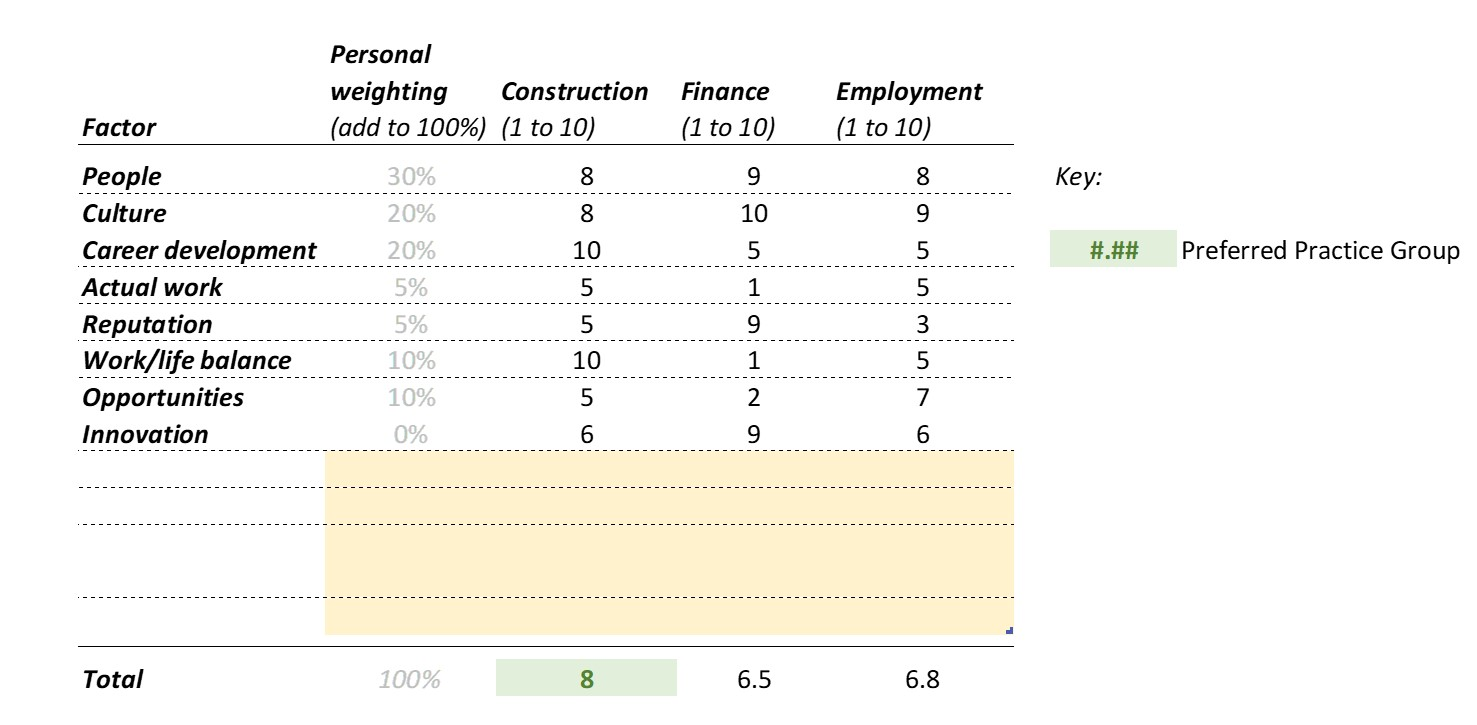
How to use it:
- Insert any additional 'Factors' that matter to you.
- Insert the practice groups you're considering (e.g. construction, finance) across the top row.
- Insert a percentage in the 'Personal weighting' column for each factor, depending on how important it is — the weightings should total 100%.
- Score each factor for each practice group (1–10).
- The practice group with the highest score is highlighted green.
Feel free to amend the numbers — this isn't an exact science. Sometimes you flip a coin between two options and realise what you actually want while the coin's mid-air.
Factors to consider
People
Mentorship — do your colleagues give honest feedback and clear instructions, teach you to improve, and care about your goals? Lifestyle — what are their lives like; can you see yourself living like them? Clients — who are you ultimately working for, and do you care about them?
Culture
Is the team collaborative or competitive? Do they invest in juniors or see them as labour (listen to how they talk about past and present juniors)? Long tenure often signals good culture.
Career development
Have people been promoted from your position and stayed? How have they developed their skills? Is the training formal, or hands-on with partners?
The actual work
Are you interested in the subject matter? Do you like the flow — litigation and regulatory work is more consistent, while transactional project work alternates intense periods with quiet ones. Look at what people 1, 3, 5 and 10+ years in are doing, and whether you can picture yourself enjoying it.
Reputation, work/life balance, opportunities and innovation
Are the team and its matters highly rated (rankings, or matters in the news)? What are the hours, billables attitude and flexibility like? What travel, secondment and exit opportunities exist? And is it a team or sector working on innovative opportunities?
Things you can do to get more info
- Research — never underestimate Google; Harvard Law School also has a good practice-area guide.
- Virtual internships — a range of free ones are available at theforage.com.
- Reach out — connect via LinkedIn or alumni pages with a short message:
"Hi [name], I hope you don't mind me reaching out — I'm very interested in [competition & consumer law] and noticed your impressive career in this space. If you've got time in the next few weeks, I'd love to connect over a coffee (virtual or in person) to learn more about your work. No worries if you're too busy — either way, hope you have a good week."
After you meet, follow up — and it's always nice to let them know if you end up working in the area.
Final thoughts
Trust your instincts, but use something like this framework if you're stuck. And remember you're not locking in the rest of your career — I've known private-practice construction lawyers who moved in-house, and people who started in generalist suburban firms and became BigLaw partners. Your goals, preferences and opportunities all change over time.
Frequently asked questions
How do you choose a practice area as a junior lawyer?
Weigh the factors that matter to you — the people and mentorship, the team's culture, career development, the actual work and its rhythm (litigation is steadier; transactional work runs hot and cold), and things like reputation, hours and opportunities. A weighted scoring framework helps you compare options objectively.
What factors matter most when picking a legal team?
The people you'll learn from (do they give honest feedback and care about your goals?), whether the culture invests in juniors, whether people are promoted and stay, and whether the subject matter and workflow suit you. Long tenure in a team is often a good sign.
Does choosing a practice group lock in your career?
No. Your goals, preferences and opportunities all change — construction lawyers move in-house, suburban-firm lawyers become BigLaw partners. Use a framework if you're stuck, but treat it as a current best guess, not a life sentence.
Part of the Field Guide
This is 1 of 110+ guides
The full library adds templates and learning tracks — one payment, lifetime access.
Get the next guide in your inbox
One short, practical email most weeks. No spam — unsubscribe any time.